September 5, 2026
How to Layer Kick Drums That Punch Through Any Mix
Three kick samples stacked on top of each other, all EQ’d to boost 60 Hz, and the mix still sounds thin. I’ve been there. Most layering advice tells you to add more, when the fix is usually adding less and being surgical about where each layer lives in the frequency spectrum.
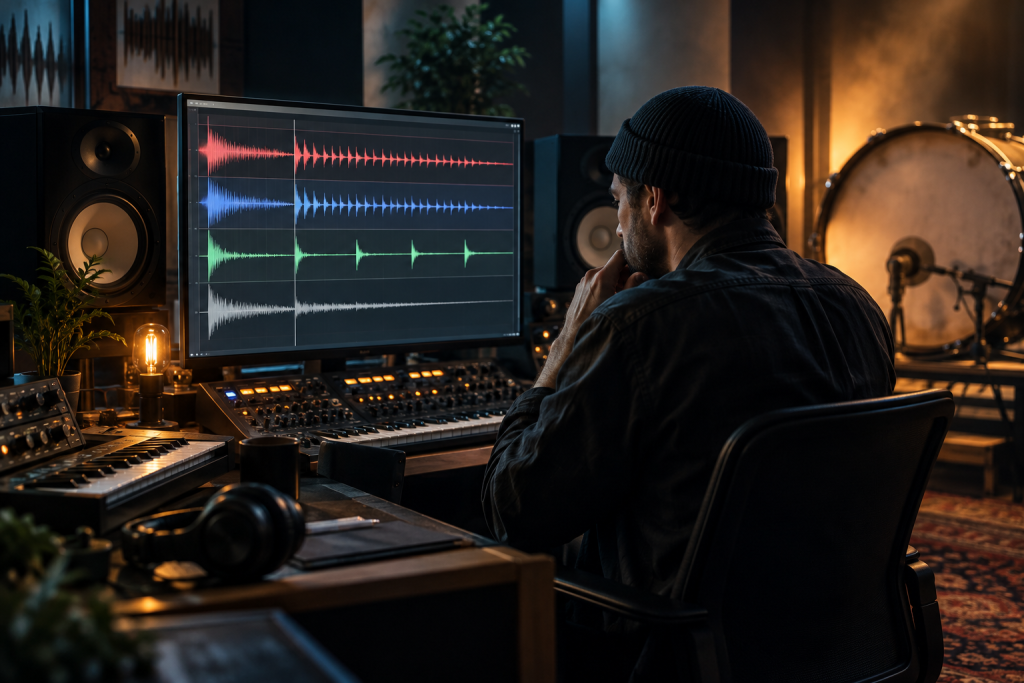
Kick layering is one of the few places where stacking actually works. The catch is that it works only when every layer has a clear job, and when you stop treating the low end like a place to dump everything.
Why Kick Layering Works (And Bass Layering Doesn’t)
Layering is genuinely popular with kick drums, and for good reason: it can create new distortion and a kick sound that doesn’t exist anywhere in your sample library. That’s real value. But the same logic does not transfer to bass.
Layering bass is a mistake. It gets chaotic fast, with some notes louder and others quieter, and beginner producers who stack bass layers tend to end up with a useless track. The reason is simple: a bass line plays a range of notes, and two stacked bass sounds will interact differently at every pitch. A kick is a single hit. You can control it in a way you can’t control a moving bass line.
So the low-frequency range should hold one bass and one kick. That’s it. Everything else in your arrangement needs to stay out of that zone.
The Three-Layer Kick Structure
A working kick almost always breaks into three functional bands, not three random samples:
- Sub layer (roughly 40 to 70 Hz): the weight you feel more than hear. A clean sine or a heavily filtered 808 tail lives here.
- Body layer (roughly 80 to 150 Hz): the punch that translates on smaller speakers and earbuds. This is where most “my kick disappeared on my phone” problems get solved.
- Click/attack layer (roughly 2 to 6 kHz): the transient that tells the ear a hit happened. Snares and hi-hats mask this range, so it needs to be sharp.
Each layer gets one job. If you find yourself boosting two layers in the same band, one of them is decoration. Cut it.
Choose Sounds That Already Work
Here’s the part nobody wants to hear. If a sample isn’t what you wanted, processing won’t save it.
The quality of a sound does not improve with equalization and compression. You can’t EQ a weak kick into a strong one, and you can’t compress your way to a better transient. The best approach is to find instruments that already sound the way you want them. This goes double for kick and snare, the elements holding your rhythm together.
So before you start stacking, audition. Pull up ten kicks, not one. If none of them have the punch you’re after, keep looking. The right sample needs a shelf cut, not a rescue mission.
Fewer Layers, Better Sounds
When producers first learn about layering, they pile on samples trying to make something huge. What they get is a pile of sounds, not a big new sound. Layering three mediocre kicks just gives you three mediocre kicks fighting each other.
Pros layer with intent and add as few layers as possible, because they know exactly what each layer brings. The order of operations matters: get the best possible single kick first, then ask whether it actually needs help. Often it doesn’t.
Making the Layers Sit Together
Once you’ve got your two or three layers, the work is subtractive, not additive.
- High-pass the click layer hard. Everything below ~1 kHz is dead weight that will muddy the body.
- Low-pass or shelf-cut the sub layer so it doesn’t bleed into the body range. A clean sine doesn’t need a wide footprint.
- Align the transients. Nudge the click layer a few milliseconds ahead of the body so the attack reads before the weight. This is often the difference between a kick that cuts and one that smears.
- Check phase. If a layer makes the whole kick quieter when you un-mute it, flip its polarity. Phase cancellation is the invisible thief in every layered kick.
You can also skip stacking entirely and get there with a drumsynth. Something like Beatsurfing’s VRAC splits the interface into Global and Per Pad sections, with a Drumify knob for the whole kit and separate versions for individual pads, plus Pan and Pitch per pad. The X/Y approach lets you sit in the hybrid space between two distinct sounds rather than committing to one. It’s not a traditional drum machine, and it’s not trying to be.
Carving Space for the Kick in the Mix
Getting the kick right in isolation is half the job. The other half is protecting it.
Place your one bass and one kick so they’re mostly present in different bands. If they do share frequencies, use sidechain compression to attenuate the bass when the kick hits. This is standard for a reason. When a bass line follows the kick note for note, the two are competing for the exact same energy, and sidechain is how you let both breathe.
Beyond the bass, keep other instruments out of the low-frequency range entirely. Pads, pianos, and synth stabs with low-end content are the usual offenders. High-pass them. The kick and bass own that zone.
Be careful down there, because this part of the spectrum is delicate and it’s easy to create a conflict. When the lows are overloaded, they sound terrible and eat your headroom, which makes the whole track quieter.
Sidechain, Not Surgery
There’s a tempting fix for frequency fights: aggressive EQ to carve out space. In many cases, when instruments really clash in the same range, that equalization substantially damages the sound.
The better move is to not create the conflict in the first place. Choose kick and bass samples that already occupy different territory. That way the EQ you reach for is a gentle shape, not a scalpel fighting a wound you made yourself.
What Actually Matters
Stack two or three kick layers max, give each one a defined band, align the transients, and check phase before you do anything else. Use sidechain to separate kick and bass instead of EQ surgery that wrecks both. And start with samples that already sound right, because once you’re boosting 60 Hz on three layers, you’re already past the point where mixing can save you.
The producers whose kicks sound huge usually aren’t running a five-layer stack. They found one great sample, added one supporting layer with a clear purpose, and got the arrangement out of the way.
No comments