September 16, 2026
Free Drum Kits vs Paid: A Producer’s Honest Take After 10 Years
Somewhere around 2016 I stopped buying drum kits. Not on purpose. I just noticed one day that my best beats weren’t the ones with the expensive samples in them, they were the ones where I actually knew where every kick and snare was supposed to sit. Ten years and a lot of wasted money later, here’s what I actually think about the free drum kits vs paid drum kits argument. It’s messier than either camp admits.
The short version: free kits are not worse by default, and paying money does not make a kit hit harder. But paid kits and free kits are good at fundamentally different jobs, and if you don’t understand which job you’re shopping for, you’ll waste cash either way.
What you actually get when a drum kit costs nothing
Free kits come from three places: labels pushing a producer they’re invested in, plugin companies using a freebie as a funnel for a paid product, and one-off giveaways where a sound designer dumps a folder to build a mailing list. All three are legitimate. I’ve pulled keeper kicks out of all three.
The real problem with free kits isn’t quality, it’s curation. Nobody has an incentive to give you 40 perfectly gain-staged, key-labelled, processed 808s for free. They have an incentive to give you 700 files, call it “Trap Essentials Vol. 3”, and let you dig. That volume is a feature if you like digging, and a trap if you’re trying to finish a beat tonight.
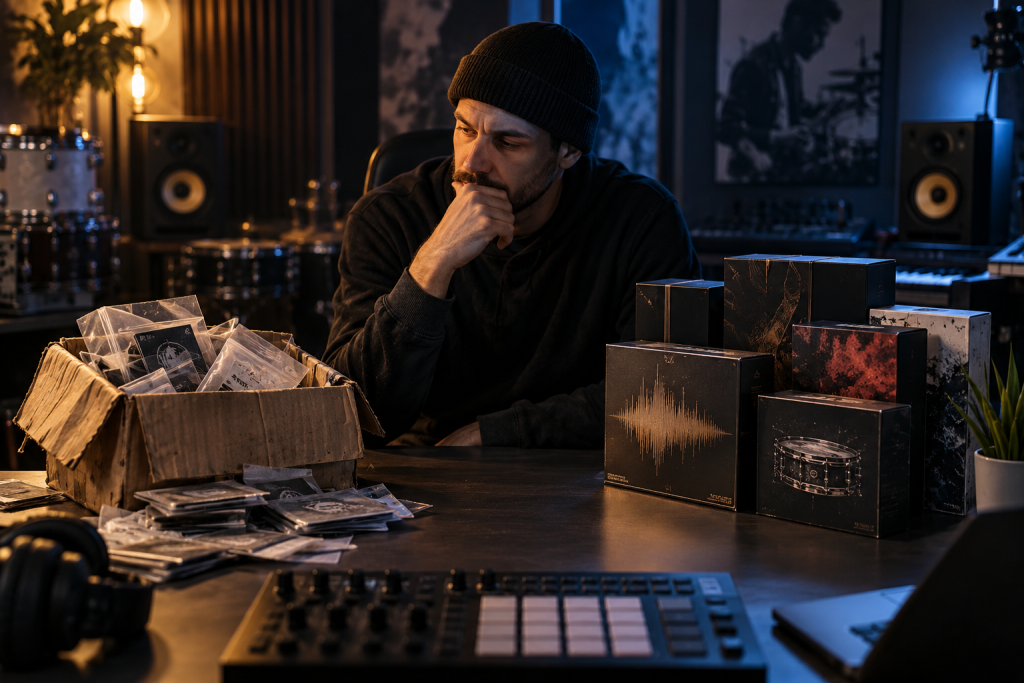
That’s the honest split. Free kits hand you raw material. Paid kits hand you a curated, opinionated palette with a specific sound already baked in.
What you’re actually paying for in a paid kit
Nobody charges $30 for samples. They charge $30 for one of four things, and you should be able to name which one before you click buy.
- Engineering. Pre-processed one-shots that are already compressed, EQ’d, and pitched to sit in a mix without you touching them. This is the most common reason a paid kick “just works”.
- A sound identity. Every sound in the kit belongs to the same sonic world. Dump the whole folder on a beat and it’s cohesive. Free kits are usually a grab bag, so you get a hodgepodge of tones that fight each other.
- Recreation of a specific sound. A kit modelled on an identifiable record or era. Useful when you’re spotting a reference and need to nail it.
- Convenience. Named, keyed, layered in advance, tagged, sorted. This is a workflow tax you’re paying to skip.
If the paid kit you’re looking at doesn’t clearly check one of these boxes, you’re buying the same thing you can download for free, just with a nicer cover.
Why “free sounds worse” is mostly a myth
A clean sample is a clean sample. If a free 808 was recorded or synthesised properly, there is no hidden degradation that shows up later. The processing chain doesn’t care where the file came from. It cares whether the source is clean and whether you know what to do with it.
I’ve heard this point made well elsewhere: free tools get used on paid work all the time, and the difference between free and paid is usually in the analogue modelling, the metering depth, and the interface that helps you make decisions faster. None of that changes what’s achievable. The same logic applies to samples. A well-made kick is a well-made kick.
Where paid kits genuinely pull ahead is at the front of the workflow, not the back of it. It’s about how fast you get from “I want this beat to hit” to “there it is”.
The real cost of free kits
Here’s the part nobody says out loud. Free kits cost you time and they cost you mental overhead. You pay for them with the 40 minutes you spend auditioning 200 kicks for the twelfth beat in a row, and with the fact that a cluttered sample folder makes it harder to know what you like.
The producers I know who make the most music have a trimmed library, not a huge one. Constant downloading is usually a symptom of not trusting your own choices yet, not a symptom of scarcity. That’s a hard thing to admit, and I spent years proving it the expensive way.
When free kits win
Free kits are the right call in a few specific situations, and this is where most people who buy a lot of paid kits get it wrong.
- You’re learning. You need volume to develop taste. A hundred free kits will teach you what a good snare sounds like faster than one $40 premium kit will.
- You need a specific one-off. A weird percussion hit, a random foley texture, something you’ll use once. Not worth the price of admission.
- You’re experimenting with hybrid approaches. Random samples, layered and pitched and flipped, often end up as a signature kick that nobody else on earth has. Free kits are the perfect raw fuel for that.
That last one matters more than it sounds. The stuff that becomes your sound is usually the stuff you mangled, not the stuff you bought. You develop muscle memory by playing with your own samples, and that instinct is worth more than any single one-shot.
When paying is actually the right move
Buy a paid kit when the kit has a clear sonic identity that matches the record you’re trying to make, or when the convenience is worth the money because you’re on a deadline. A cohesive drum kit that lets you build a track in 20 minutes instead of 2 hours is not a luxury, it’s just prioritising the work over the shopping.
Buy it because it saves time, or because it gives you a colour you can’t get elsewhere. Do not buy it because it’s paid, and therefore somehow more serious than the free folder sitting on your drive. That’s the same mistake as the person who thinks a $200 plugin sounds better than the free one on principle. It doesn’t.
What I actually do
I keep one paid trap kit that I trust for the base layer of every beat, because I know exactly where the kick sits and I can build fast. Everything else, textures, snaps, unorthodox percussion, weird one-shots, comes out of free kits. That’s the balance I landed on. A small paid foundation for speed, a large free library for flavour.
The shopping is not the beat. Nobody will ever ask where your kick came from. They’ll only ask if the beat goes. Whether the files are free or paid, that’s the only test that matters.
No comments